Alternative drive systems
As, the largest transport company in the city of Chemnitz, CVAG is directly challenged to actively shape the transport transition in Chemnitz and to improve the quality of life in our city in a sustainable manner. While we have been synonymous with electric mobility in the tram sector for almost 130 years and have been running on ‘green electricity’ since 2017, we are now increasingly testing and implementing alternative forms of propulsion.
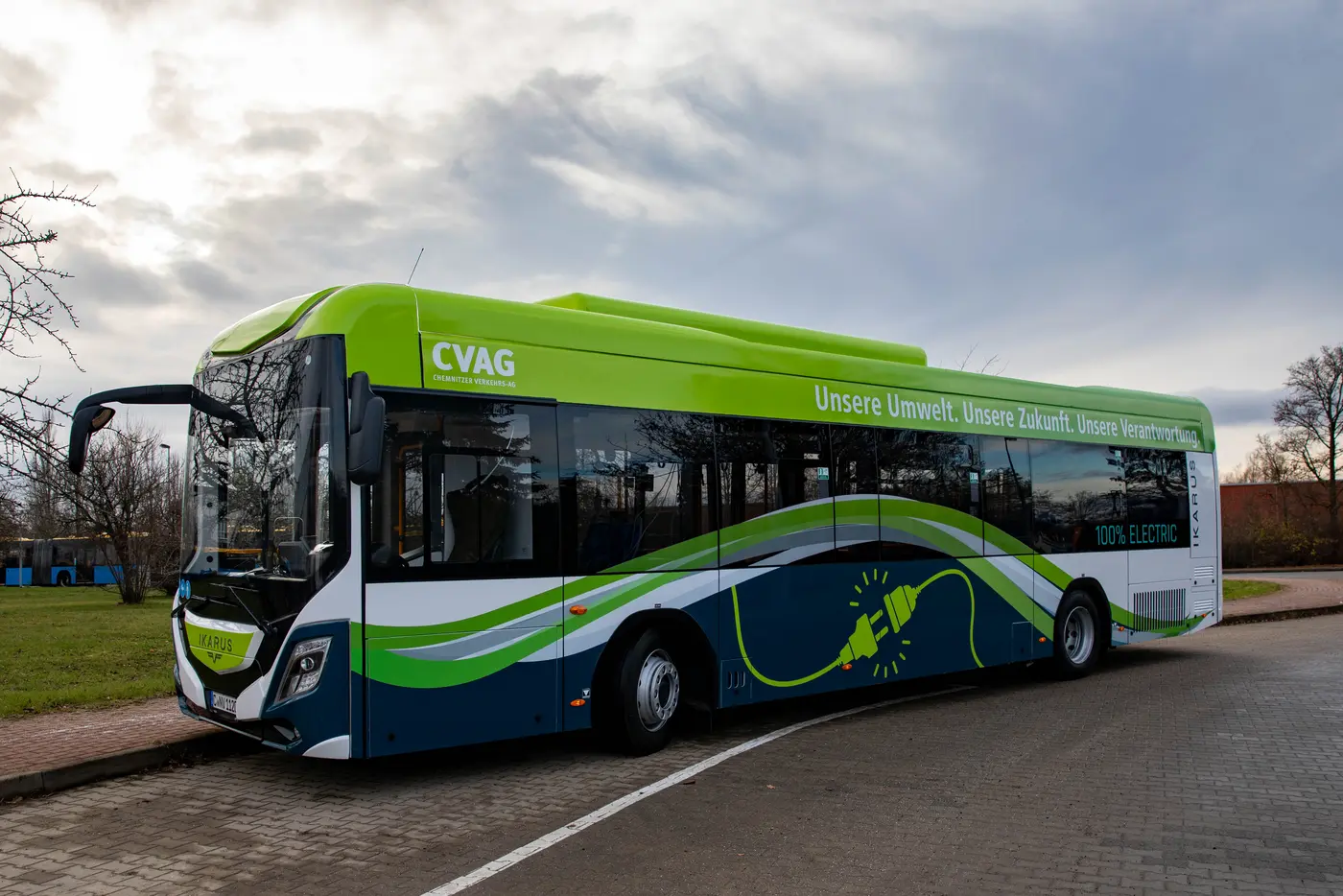
Ikarus 120e electric bus
A 30-month test phase with an Ikarus 120e will run until April 2028, taking into account weather changes and extreme temperatures. The model from manufacturer ELECTROBUS EUROPE ZRT (a member of the Ikarus Group) is a standard low-floor bus with 26 seats and standing room for 64 passengers, a maximum output of 240 kW and a battery capacity of 314 kWh.
During the test, the Ikarus 120e will be used on all standard bus routes for a specific period of time in order to evaluate consumption data and charging times. The necessary charging infrastructure, with a 600V and 50kW charging station, is available at the Werner-Seelenbinder-Straße depot.
You can find all the information about the test phase in our press release (in German language).

Biogas hybrid buses
- Procurement of 30 accessible low-floor buses with biogas hybrid drive in 2022/2023
- Funding from the European Regional Development Fund (ERDF)
→ Funding amount of 9.5 million euros, corresponding to 70 per cent of eligible costs

Diesel hybrid buses
- Procurement of 15 accessible low-floor buses with diesel hybrid drive in 2021
Funded by money from the Local Authority Transport Financing Act

What makes the new buses special is the use of hybrid technology. This combines a combustion engine and an electric motor. The energy recovered by the electric motor during coasting and braking is stored via the inverter in the capacitors (supercaps) installed on the roof. During start-up and idling, the stored energy is fed back to the electric motor, thus supporting the engine. The hybrid drive does not serve to increase the maximum power of the bus, but rather to reduce the load on the engine.
- Diesel hybrid buses can save up to 8.5 per cent fuel compared to conventional diesel engines. Based on CVAG's consumption and the annual mileage of its buses, this means savings of up to 9.5 tonnes of CO2 per bus per year. This translates to a CO2 reduction of up to 142.5 tonnes per year for these 15 buses.
- The purchase of 30 new biogas hybrid buses in Chemnitz will save up to 1,271 tonnes of CO2 per year.
A glimpse into the future: hydrogen and electric buses
We want our vehicle fleet to contribute to reducing greenhouse gases and are constantly developing our fleet to make it CO2-neutral. To this end, we are testing and implementing alternative drive systems.
With Chemnitz as a national hydrogen competence centre, hydrogen as an energy source is naturally also an important topic for us. Provided we receive financial support, we aim to procure and test two hydrogen buses in the medium term.
Our subcontractor, the company Reichelt, is already using an electric minibus on line 89. We are supporting this by providing the necessary charging infrastructure.
Electric vehicles in our company car fleet
We are also increasingly focusing on electric vehicles in our company car fleet.
This measure is financed by the European Union – NextGenerationEU.
